|
Hannah Roberts –
Simon Parkin |
|
|
Beethoven |
Sonata in F major op. 102 |
|
Samuel Barber |
Cello Sonata |
|
|
|
|
Serge Rachmaninov |
Cello Sonata |
Hannah Roberts – ’Cello
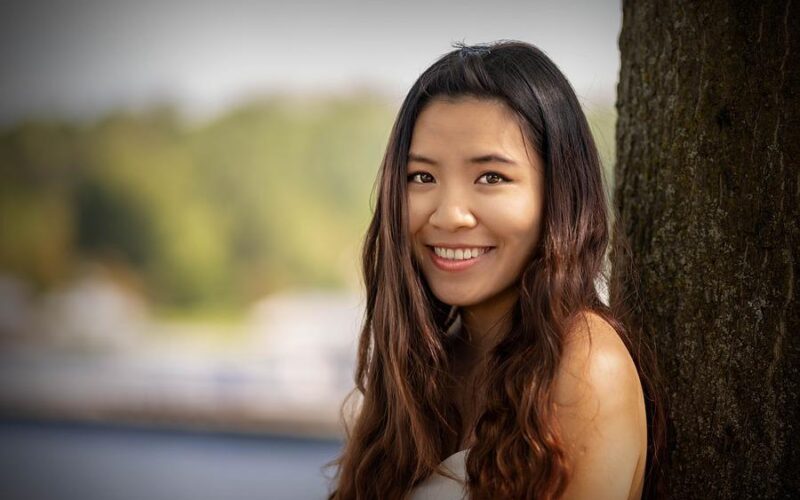
HANNAH ROBERTS is one of the outstanding ’cellists of the younger generation.
She feels privileged to have worked closely with the late William Pleeth at the
Yehudi Menuhin School, and with Ralph Kirshbaum at the Royal Northern College of
Music.
Hannah has won many awards, including prize winning finalist in the BBC TV Young Musician of the Year, and Silver medal for a performance of the Elgar Concerto with the LSO at the Barbican during the Shell/LSO Competition. She was also declared joint winner, with composer and pianist Simon Parkin, of the International Morley College Centenary Concerto prize, playing a concerto written for her by the composer. Prestigious awards have also included the Jacqueline du Pre memorial award and the Pierre Fournier award, as a result of which she gave a highly successful debut recital at the Wigmore Hall. Among her competition successes have been the Tunbridge Wells Young Concert Artists Competition and the Radio 2 Young Musician of the Year.
Since making her concerto debut aged 16 at the Royal Festival Hall in London, Hannah has given numerous concerto performances with leading orchestras, including the London Mozart Players, LSO, BBC Concert Orchestra, and the Hallé. She has also made frequent broadcasts for BBC radio. Festival appearances have included Chichester, Malvern, Beverley, and the recent ‘Beethovenfest’ in Manchester. In addition to her acclaimed duo partnership with husband Simon Parkin, Hannah has enjoyed working with the late Lord Menuhin, pianist Martin Roscoe and violinist Tasmin Little, with whom she has recorded for ASV.
She is much in demand as a teacher and is frequently invited to give master classes in addition to her posts at the Royal Northern College of Music and Chetham’s School.
Hannah plays on a fine Grancino instrument of 1695.
Simon Parkin was born in Manchester and at the age of ten won a place at the Yehudi Menuhin School where his teachers included Marcel Ciampi, Vlado Perlemuter and Nadia Boulanger.
Subsequent study was in Manchester where he gained concurrent degrees at the University and the Royal Northern College of Music, where his composition teacher was Anthony Gilbert.
He secured a lectureship at the RNCM upon graduation and has taught both composition and improvisation at the Menuhin School.
As a composer Simon has had many broadcasts and performances in the UK, on the continent and in the USA. He has had pieces performed at the Park Lane Group series in the Purcell Room on three separate occasions, won an international prize with a cello concerto written for his wife, Hannah Roberts, and had a large scale choral work broadcast twice on German radio.
He has also broadcast on BBC radios 1, 2, 3, and 4 as well as Classic FM, BBC TV, ITV and Channel 4, and has had articles published by BBC Music Magazine.
Concert experience started while still at school and is now extensive, with a range of internationally acclaimed partners. His duo with Hannah Roberts has been acclaimed in The Strad for its “rare ensemble and musical intelligence”.
Sonata No. 4 in C. Op. 102 No. 1 (1815)
1. Andante - Allegro Vivace
2. Adagio - Andante - Allegro Vivace
Beethoven would be the role model for anyone seeking to build complex and subtle structures from the simplest of material. The four-note scale that opens this sonata is woven immediately into an imitative texture, crystallising into its inversion for the finale. The following five notes form the basis of the first movement Allegro, and the final five notes of this initial cello phrase form the opening to the slow movement. This sense of no note being wasted gives the piece its incredible compactness and concentration.
Through little touches – hesitations, brief outbursts, moments of frozen indecision in suspended tonality – one gets a sense of an intense human personality living behind this music. It is the combination of a volatile character with an almost religious self-discipline that gives Beethoven’s later music so much of its fascination.
© Simon Parkin
Sonata Op. 6
Allegro ma non troppo
Adagio – Presto – Adagio
Allegro appassionato
Barber, who died in 1981, wrote throughout his life in a lush, post-romantic idiom, with a marked lyric gift (he was an accomplished baritone), flexible use of rhythm and assured counterpoint. If anything, his harmonic language became more ‘advanced’ as his life progressed.
The Cello Sonata, written when he was only 22 and dedicated to his composition teacher at the Curtis Institute, uses triadic harmony, and is firmly rooted in an inflected C minor. The writing for both instruments is idiomatic and skilful, and there is a distinctly American cast (open, optimistic, eclectic) to much of the material. The post-Rachmaninov gestures are powerful and effective throughout, and of particular note are the rhythmic tricks in the scherzo section of the middle movement, and the thematic transformations of the finale.
The sonata has become one of the most enduringly popular American chamber works, and one of the very few to approach the status of ‘standard repertoire’ on the cello.
© Simon Parkin
Sonata in G minor, op. 19
Lento - Allegro Moderato
Allegro scherzando
Andante
Allegro Mosso
Rachmaninov had to contend with a common problem in the Romantic Sonata: how do you incorporate strongly characterised, emotionally loaded, self-contained material into a structure that since Beethoven has become evolutionary, developmental in its purpose? There are some moments of rather dutiful development in the outer movements of this sonata, but on the whole the strength of the material, the control over the emotional pace, carries the work. There is the unifying device of the semitone with which the piece opens, and a heady combination of melancholy and heroic strength which is pervasive.
The Cello Sonata was written shortly after the 2nd Piano Concerto, with which it shares many characteristics. With the help of financial support from his cousin, Rachmaninov was just emerging from a period of depression. He was eventually to seek a living as a pianist – his technical capacity, huge frame and large hands were legendary – and his piano writing tends to exploit this, with constant employment for spare fingers in extended positions. The cello writing is full of warmth and character, however, and the sonata is an example of true chamber music.
© Simon Parkin
’Cello
& Piano Recital 25 November, 2000
Hannah Roberts (’Cello), Simon Parkin (Piano)
CHAMBER MUSIC DEFIES A GALE
On yet another miserable and blustery night, Swansea Museum has been the venue of a stunning musical evening. Last January, Hannah Roberts and Simon Parkin delighted the Crwth audience with a broad range of music for cello and piano. On Saturday, in contrast, they focused our attention on just three sonatas. Beethoven’s beautiful fourth, as Simon Parkin explained in his illuminating programme notes, is a piece of music in which ‘not a note is wasted’. Following this we had a less well-known sonata: that of Samuel Barber, composed when the American was only 22 years of age. In introducing it, Simon pointed out how often Barber had been used in American films and this information led some of us to fear the worst. What we had, however, was some quite wonderful and exhilarating music, Hannah Roberts’ lower notes in particular filled the Museum’s lecture theatre with the kind of sound of which Yamaha can only dream. The third and final sonata was that of Rachmaninov. This was a piece where, to quote Simon again, if there was a spare finger, Rachmaninov (in contrast to Beethoven) found a note for it to play. Certainly Simon was kept very busy whilst Hannah produced yet more exquisite sounds from her wonderful cello.
A brave and enthusiastic audience of over fifty were rewarded with a magnificent performance from two of Britain’s most accomplished musicians. The next concert in the Crwth series is on 21 December when Gina McCormack on violin, accompanied by Rebecca Holt, will perform a programme featuring Mozart, Prokofiev, Debussy and Brahms. Thanks to Crwth, we will have the opportunity to hear in Swansea some more world-class chamber music (for further details phone 01792 548231 or visit crwth.org.uk). Let’s hope that the weather has given in by then.
BB